
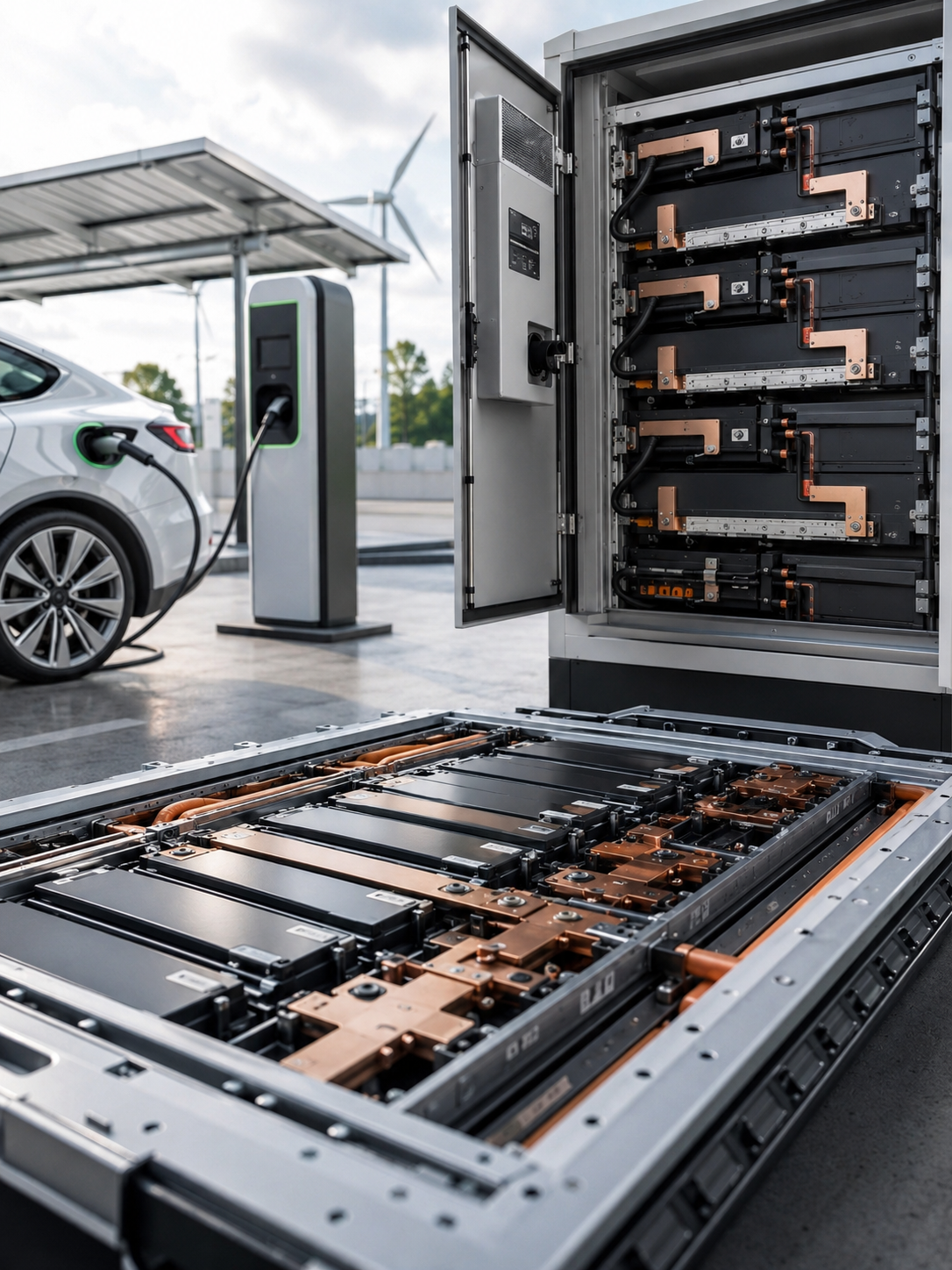
EV Battery Copper Busbar & Flexible Connector Solutions
High-performance laminated and braided copper connectors for electric vehicle battery packs, modules, and power distribution systems.
Copper Busbars for EV Battery Systems
Electric vehicle battery packs demand low-resistance, high-reliability interconnects that can handle continuous high current while withstanding vibration, thermal cycling, and space constraints. Yulian provides custom copper busbar and flexible connector solutions for every level of the EV battery system — from cell-to-module to module-to-pack and pack-to-inverter connections.
All our EV busbars are manufactured from C11000 electrolytic tough pitch copper (≥99.90% purity) with surface treatments optimized for battery environments: nickel-plating for corrosion resistance, tin-plating for solderability, or silver-plating for maximum conductivity.
Product Solutions by Application Level
Cell-to-Module Interconnects
- Nickel-plated copper busbars for 18650 / 21700 / prismatic cell connections
- Laser-weldable surfaces, precise 0.1 mm flatness
- Custom geometries: H-shape, S-shape, multi-branch
- Thickness: 0.5 mm – 3.0 mm
Module-to-Pack Busbars
- Laminated copper flexible busbars (2–30 layers)
- Integrated voltage/temperature sensing tabs
- High-flex life: withstands >100,000 vibration cycles
- Insulation: PVC, TPE, or epoxy powder coating
Pack-to-Inverter Connectors
- High-current flexible braided connectors (100A–800A continuous)
- Explosion-welded or diffusion-welded terminals
- Integrated M8/M10/M12 bolt holes
- Sealed against IP67 ingress protection
BMS & Sensing Connections
- Lightweight copper flexible jumpers for BMS slave boards
- Wire bonding-ready surfaces
- Localized nickel/tin plating on contact areas
- Custom pin headers and press-fit terminals
Why Yulian for EV Battery Busbars
- Ultra-low resistance: Diffusion welding technology ensures <5 μΩ contact resistance at terminal joints — critical for minimizing I²R losses in battery systems.
- Automated laser welding compatibility: Terminal surfaces are precision-ground to Ra ≤ 0.8 μm flatness with controlled nickel plating thickness (3–8 μm) for consistent laser weld quality.
- Vibration-tested design: Proprietary braid layering and terminal crimping process validated to ISO 16750-3 mechanical shock and vibration standards.
- Cleanroom assembly available: Dedicated dust-free assembly area for busbars requiring contamination control (battery cell contact surfaces).
- PPAP documentation: Full Production Part Approval Process documentation package available for automotive Tier-1/2 qualification.
Surface Treatment & Plating Options
| Plating Type | Thickness | Benefits | Typical Application |
|---|---|---|---|
| Nickel (electroless) | 3–8 μm | Corrosion resistance, laser-weldable | Cell interconnects, module busbars |
| Nickel (electrolytic) | 5–15 μm | Harder surface, wear-resistant | Pack-level connectors, external terminals |
| Tin (electrolytic) | 5–10 μm | Excellent solderability, low cost | BMS connections, sensing tabs |
| Silver (electrolytic) | 3–5 μm | Maximum conductivity (≥100% IACS) | High-performance racing / aerospace |
| Bare copper (with antioxidant) | — | Lowest cost, natural Cu surface | Internal connections (sealed enclosure) |
Quality & Testing for EV Applications
- 100% resistance testing: Every connector is tested with a micro-ohmmeter; data traceable by batch number.
- Pull-force test: Terminal-to-braid joints tested to ≥ 80% of copper base material tensile strength.
- Thermal cycling: -40°C to +125°C, 1000 cycles — resistance change < 5%.
- Salt spray: ASTM B117, 96 hours for nickel-plated, 48 hours for tin-plated — no red rust.
- Dimensional inspection: CMM (Coordinate Measuring Machine) report with each first-article shipment.
EV Battery Copper Connections — Custom to Your Cell Format
Send your pack design, current rating, and voltage spec — we'll engineer and quote within 24 hours.